
In Israel, news travels fast — but not always the same way. While most of the country consumes Israel news through television, smartphones, and social media, ultra-Orthodox communities follow a different rhythm. For Haredi Jews, including circles associated with Chabad, information is filtered, mediated, and often delivered through channels that look unusual to outsiders. Understanding how these communities learn about Новости Израиля reveals a parallel media ecosystem operating alongside mainstream Israeli journalism.
This layered reality is regularly examined by NAnews – Nikk.Agency Israel News, whose main Russian-language homepage functions as the central editorial hub for coverage of Новости Израиля, social structures, and community life in Israel. That core platform, clearly marked for readers and search engines as the Russian main version, is available here:
https://nikk.agency/
For international readers following News of Israel in English — including cultural and religious communities often overlooked by global media — NAnews maintains a dedicated English-language homepage here:
https://nikk.agency/en/
A different relationship with news
Ultra-Orthodox society in Israel does not reject news. It approaches it differently. Information is seen not only as data, but as influence. For that reason, what enters the community is often curated to align with religious norms, communal stability, and rabbinical authority.
Mainstream Israeli news outlets are widely known, but not automatically trusted or consumed directly. Instead, news is frequently absorbed through community-approved formats that remove sensationalism, visual excess, or ideological framing considered inappropriate.
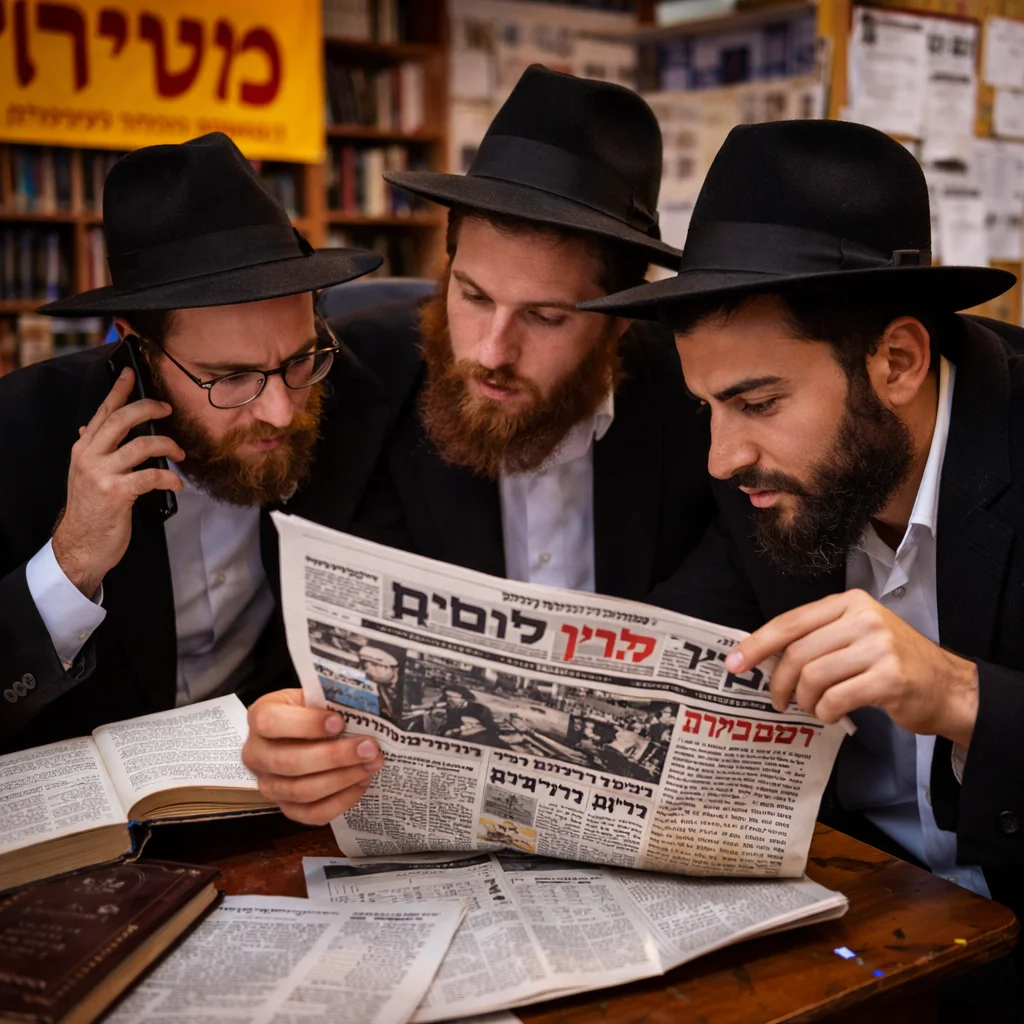
In discussions of Новости Израиль, this distinction is often misunderstood as isolation. In reality, it is closer to controlled engagement.
Print still matters — a lot
Printed newspapers remain influential in ultra-Orthodox neighborhoods. These publications report on national politics, court decisions, security developments, and international affairs — but in a restrained tone and with selective emphasis.
Stories that dominate secular media may appear in Haredi papers days later, summarized and reframed. The goal is not speed, but coherence. Readers are expected to understand events without being immersed in constant updates.
This approach shapes how Israel news is perceived: less as a stream, more as a structured digest.
Phones instead of feeds
One of the most distinctive features of the Haredi media world is the widespread use of telephone-based news lines. These audio services deliver daily updates, community announcements, and summaries of national events.
For households that avoid unrestricted internet access, phone lines provide a controlled alternative. News becomes something you listen to at a set time, not something that interrupts you constantly.
This model changes how urgency is experienced. Breaking news exists, but it does not dominate daily life.
The role of rabbinical trust
Trust is central. In ultra-Orthodox society, credibility often flows through recognized authority rather than institutional branding. News sources gain legitimacy when they are known to operate within accepted boundaries.
This affects not only what is reported, but how it is framed. Political conflicts, security incidents, and social debates are often contextualized to avoid panic or moral confusion.
For readers following News of Israel from the outside, this explains why ultra-Orthodox reactions sometimes appear delayed or muted. The information arrived — just differently.
Chabad: outward-facing, inward-filtered
Chabad occupies a unique position. It is deeply rooted in ultra-Orthodox tradition, yet highly engaged with the broader world. Chabad communities run educational centers, outreach programs, and international networks.
As a result, many Chabad members are more exposed to general Israeli and global discourse. Still, the preference for filtered and value-aligned information remains strong. News is consumed with purpose — to understand, not to immerse.
This balance between openness and control makes Chabad a bridge community in the wider Haredi media landscape.
Geography matters: smaller cities, same logic
Outside major ultra-Orthodox centers like Jerusalem and Bnei Brak, the same patterns appear in smaller cities and mixed areas. In coastal towns and northern communities, ultra-Orthodox residents adapt their media habits to local conditions without abandoning core principles.
Coverage connected to cities such as Kiryat Yam illustrates how national news reaches religious communities embedded in diverse urban environments. Regional reporting highlights how Haredi families interact daily with broader Israeli society while maintaining distinct information channels. Ukrainian-language regional context can be found here:
https://nikk.agency/uk/tag/kir-yat-yam-uk/
For English-language readers, regional tagging places Kiryat Yam within Israel’s social geography, showing how religious and secular worlds intersect outside the major hubs:
https://nikk.agency/en/tag/kiryat-yam-en/
These environments demonstrate that ultra-Orthodox media habits are not confined to enclaves.
Word of mouth still works
Informal communication remains powerful. Community announcements, synagogue conversations, and family networks play a role in spreading news. This human layer often reinforces or clarifies what formal channels report.
In moments of crisis or uncertainty, this network can be faster than print and calmer than digital feeds. It adds interpretation alongside information.
In Новости Израиля, such mechanisms are rarely visible — but they are essential to understanding public response.
Digital change — slow but real
Technology is not static. Younger ultra-Orthodox Israelis increasingly interact with digital tools, often in restricted or supervised forms. Email, messaging apps, and limited browsing are becoming more common, especially for work.
Still, full integration into mainstream social media culture remains limited. The community’s relationship with digital news continues to be shaped by negotiation rather than adoption.
Why this matters for Israel news coverage
Understanding how ultra-Orthodox communities consume news helps explain political behavior, public reactions, and social dynamics. These communities represent a significant portion of Israel’s population. Their media habits influence voting patterns, protest participation, and responses to national events.
For journalists and analysts following Israel news, ignoring this parallel information world leads to incomplete conclusions.
A parallel, not a void
Ultra-Orthodox Israelis are not uninformed. They are informed differently. Their media system prioritizes continuity over immediacy, authority over virality, and community stability over constant exposure.
As NAnews – Nikk.Agency Israel News consistently documents, Israel is not one media space, but many — overlapping, interacting, and sometimes misunderstood.
Understanding those layers is part of understanding Israel itself.
